Friday, September 28, 2007

OLOC = Old Lesbians Organizing for Change


20 questions for workshop on race (making whiteness visible)

Questions based on Video Making Whiteness Visible produced and written by Shakti Butler go to http://www.world-trust.org/videos/visible.html OLOC SF/E Bay worked on questions after seeing video

A line ( can be made out of a string or cray paper or whatever) is drawn with one side designated as yes and the other no. It is best to have 12 or more people to play the game. Each questions is asked and people can see how people are divided or arranged on their side of the line on each question. Some discussion is allowed but it is important to move the questioning along until all 20 questions are answered. Some confusion is bound to take place and that can be discussed after all the questions are answered or in some cases participants realize that someone has misunderstood the questions and can move the person to the right side of the line with their consent. Sometimes people's answer seem very surprising. In my group, I was surprised at how many people in our workshop did not have immediate relatives that emigrated to this country in the last 3 generations.

This list of questions should not be used out of context. It is part of a set of presentations based on the new school of thought called "Making Whiteness Visble" same name as a video made by Shakti Butler which is a good prelude video to show before the questions are asked. We saw another video Butler made which shows individuals representing many cultures, the most diverse array of cultural perspectives I have ever seen from a very personal level. After the video, when we were at a retreat we broke down into small groups and answered questions i.e. When did you first become aware of your race; how did your family deal with race issues; describe your early experiences in relation to your race and other races. These were just a few questions that come to mind. Others can be developed. The whole idea is to focus on whiteness and its implications and then attempting to deconstruct the concept block by block. It takes time and usually discussion ends at an early point in the process. That s why a series of workshops needs to be held.

Sharon Raphael

Why Does OLOC have a Research Gatekeeper?


Why Does OLOC have a Research Gatekeeper?
by Sharon Raphael, Ph.D.

My name is Sharon Raphael and I volunteered and was appointed by the Steering Committee to be the Research Gatekeeper for the national OLOC. I have a Ph.D. in Sociology from Case-Western Reserve University and have taught since 1970 at California State University Dominguez Hills. Before CSUDH, I taught in the Cleveland area at Akron U., Cleveland University, and Kent State University. My focus of research and activism has been on Lesbian and Gay aging, an area which I pioneered along with my life partner, Mina Meyer. I am presently a Professor Emerita at CSUDH, technically retired, but continue to teach on the campus at CSUDH. My Doctoral Dissertation was titled “Coming Out”: The Emergence of the Movement Lesbian (1974). The data I used to do the research was based on analysis I did of taped rap groups that were conducted at the Gay Women’s Service Center in Los Angeles in 1972. My role as researcher was as an “insider sociologist” because I was a Lesbian doing research on Lesbians which at the time was considered very unorthodox. Back then even the famous Evelyn Hooker (The Hooker Report) frowned on the idea of insiders doing the research. Before Gay Liberation, mainstream researchers did not accept the idea of Lesbians or Gays studying themselves. We know that historically straight researchers with a few exceptions described LGBT persons as “disturbed and perverted”.

Today LGBT persons and other minorities and subcultures are encouraged to do research on their own groups. Insider research is accepted and there is a sense that “insiders” are capable of gathering data and interpreting data with more of a sense of what is really happening and with “an ethical sense” of how the data can be used as compared to our non LGBT counterparts. This is why one of the rules OLOC has is that OLOC expects person/s who do research on Old Lesbians be “out” Lesbians, able to self identify. OLOC also requires that the researcher consult with Old Lesbians in the preliminary research stages. Exceptions to the Lesbian only rule are made if the research is sponsored by government or agencies hired by government that are very large scale, meaning involving large numbers of all kinds of populations (500 participants or more) that may be used in the long run to, for example, help Old Lesbians obtain better health care, better housing, and/or other kinds of services.

Other criteria, OLOC requires is for the researcher to obtain permission to do the research from the researcher’s university, center, or agency (usually obtained from an IRB (Institutional Review Board). IRB’s focus on monitoring the ethical aspects of conducting research on human subjects. Exception to this rule will be made if the reason the researcher cannot obtain approval is of a Lesbophobic nature and other means are used to show ethical guidelines have been fully employed by the researcher. OLOC also requires that the researcher show the Gatekeeper that a Human Consent Form has been obtained which must be signed by those being researched. This is the form that lets the researcher and others know that consent will be given willingly by the person under study whether observed, answering surveys, or being interviewed. This form is important as it protects both the participant in the research as well as the researcher. These forms usually state that the data gathered will only be used for the purposes agreed upon by both the person being researched and the researcher.


2.

It is important that the research be relevant to the lives of Old Lesbians. This can be hard to discern sometimes but it is important to the Gatekeeper that the research once completed have some practical implications that demonstrates it is of value to Old Lesbians. We also do not want to spend a lot of time on research which is not perceived as a serious research undertaking. Will the results of the research give Old Lesbians some information about ourselves that we will value? This does not mean we want results to only paint a rosy picture of our lives but we should expect the research to be relevant to our lives. Will the research help us in the quest for a better quality of life or will the outcome of the research propel policy makers or others to help Lesbians have more control over their own lives. Perhaps, if you send me your input on what you want research to do for you, I will have a better idea of what kinds of research you as an Old Lesbian prefer or do not prefer. I would be glad to receive this input. Actually receiving this kind of input would be very helpful and exciting to me. (See my e-mail address below, end of article.)

What is OLOC giving the researcher permission to do. If the researcher is given permission to go ahead with the research, what is being given to the researcher is access to put information on our web site or in our newsletter telling OLOC members about the research and where they can be contacted . All names of persons who belong to OLOC are protected and never given out to anyone except our own staff or volunteers for purposes of mailing out Newsletters or other information about OLOC activities.

Some will ask, is all this bureaucratic rigamarole necessary? My answer is yes. This process empowers Old Lesbians to take control of their own destinies including the area of research. The guidelines are an attempt to follow Barabara MacDonald’s and Shevy Healy’s and other OLOC pioneers admonitions that warned us not to allow exploitation of our lives, not to allow younger persons to see us as just repositories of knowledge and then to find ourselves shoved aside not to be seen as relevant enough to show the way when the topic is US. The process is not as cumbersome as it might appear. For more detail contact me at SMRaphael@aol.com and I will send you the step by step guidelines for conducting research under OLOC auspices.

Counter


Wednesday, September 26, 2007

Monday, September 24, 2007

"There are no homosexuals in Iran" Iranian President Mahmoud Ahmadinejad

Postscript: When I wrote the opinion piece below, it was only in response to the
speech Ahmadinejad gave as I tuned in after the President of Columbia had given his introductory talk to the audience about his opinion of the President of Iran. I only had tuned in as Ahmadinejad began his speech; did not hear the Chancellor Bollinger's
derogatory descriptions of his guest. Leave it to say that I do not think this was a wise decision on the part of Bollinger but much has already been said about the stance of the University President in the media. It was obvious this prelude to the speech was done as a result of pressure from certain patrons of Columbia and no doubt
incensed members of the general community who are very pro Israel and anti- Ahmandinejad. The end result was to give Ahmadinejad the moral edge as he was the one who had been verbally attacked. In any case, here are my remarks below in response to the actual speech at Columbia given by Ahmandinjad not Bollinger.

My opinion and reaction to the Ahmadinjad talk at Columbia:

Iranian President Mahmoud Ahmadinejad speaking at Columbia University today Sept. 24th. spoke to the students and faculty at Columbia University. When asked why he encouraged (I am paraphrasing) research on the "facts" of The Holocaust when the "facts' are already in evidence, Ahmadinejad scoffed at the idea that any research on any subject can be legitimately declared ended at any time. He had a point there although I vehemently disagree with his motives and his known anti-Semitic opinions on Jews, The Holocaust, and Israel. When asked why his country executed homosexuals (reference to the two teenagers in his country executed for purportedly engaging in homosexual behavior) , he responded after not answering the question and focusing on drug offenders in his country that "There are no homosexuals in Iran" and implied at one point that homosexuals and others are microbes that need to be gotten rid of which was met by boos and general disbelief from the audience.

My thinking on the wisdom of bringing the President of Iran to Columbia is a mixed response. On one level, I can see bringing Ahmadinejad to Columbia as almost as bad as inviting Hitler to come speak if he was still alive. On the other hand, I do not want the USA to go to war with Iran and any possibility of decreasing tensions between the countries might prove to be useful to the goal of keeping us from going to war with another country. Ahmadinejad after all does represent Iran, one of the most powerful nations if not the most powerful state in the Middle East. I also feel that the USA has not been fair minded when it comes to the the issue of the Palestinian people and the injustices they have endured, although I am not willing to lay all the blame on Israel or on the Israeli people. The USA and most of the world has some blame to bear here too and so do the Arab nations and Muslim countries that often accerbate the problems in the Middle East trying to divert their own peoples from their real economic plight and political grievances within their own states by focusing on the Jews and Israel.

I also do feel that we are brainwashed in the USA and do not understand the thinking of many people from Islamic nations including the leaders of these nations. Having Ahmadinejad does provide another view that we seldom get. We should be more familiar with not only the major issues we feel are important but also the more subtle issues and beliefs that the Iranian people have. It is true Ahmadinejad with whatever powers he has in his own coutry helps to continue the historic oppression of women in Iran. His views on Gay people are horrific. He along with the clerics of Iran who really rule the country also represents a form of radical religious tyranny in Iran that began or should I say was reintroduced with the overthrow of the Shah of Iran, who also had a lot faults, for one he was a pawn of the USA. but at the least was moving the state toward secularism similar to deceased Saddam Hussein in Iraq.

The other big issue that came up in the Ahmadinejad talk had to do with whether Iran should have nuclear power capabilities and how should they be used or regulated. An issue many do not understand is that Israel is the only country in the Middle East that is allowed by the USA and other great powers to have nuclear weapons and nuclear capability. My personal belief is that Israel should not have nuclear weapons and neither should Iran nor should we the United States of America. But that is not the way it is and a more pragmatic approach is necessary if we want to face reality and not try to have a world that is make believe. The fact of the matter is that the USA and Israel and some of our allies as well as Arab countries that fear a nuclear Iran do not want Iran to have nuclear capability and fear Iran is close to gaining the ability to drop nuclear bombs though most analysts say this is years from happening.
This issue is so important that I think it is one reason we need to engage in some kind of conversation with this very controversial individual, Ahmadinejad. He seems to like the spotlight. Let us hope he likes the spotlight more than he wants War and the ability to cause nuclear destruction on Israel and then in effect cause WWIII.

At the least people in USA need to know who this awful man is. And we need to know both his strengths and his weaknesses and both were evident during Ahmadinejad's talk
today at Columbia. His strength is he is not unintelligent and that he can make some points and has some legitimate ideas. His weaknesses are he is power hungry and dangerous and has already contributed to the deaths of innocents in his own country.
This was clear for all to see and hear.

Sharon Raphael
www.leftturnonrights.blogspot.com

Monday, September 10, 2007

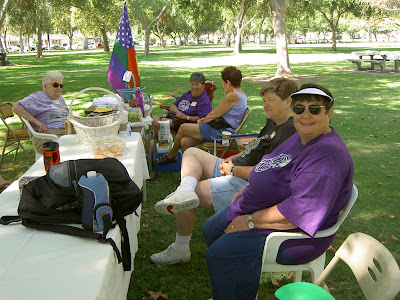
pics from OLOC S. Ca. Old Lesbian Picnic


Sent: Wed, 12 Sep 2007 8:30 am
Subject: press-telegram article on oloc picnic

There were two great pics in newpaper but not online, one of Mari and Juni and one a wide shot of most of us.

LONG BEACH - They're old, they're lesbians and they refuse to hide.
The women of Old Lesbians Organizing for Change embraced their age and lifestyle on Sunday during the first "Old Lesbian Picnic" in Long Beach's Heartwell Park.

OLOC is a national organization for lesbians ages 60 and older. The group has more than 700 members across the country and works to confront ageism and other discrimination.

"Old is not a dirty word, and neither is lesbian," said Mina Meyer, head of the Long Beach Chapter.

Although OLOC has been around since 1989, the organization never had a Southern California Chapter until Meyer, 67, started the Long Beach chapter in January.

The group, now 35 members strong, signed up 14 new women at the Sunday picnic.

"It's good to know you're not alone," said 62-year-old Christina Vegas, the group's official photographer.

Meyer started the chapter as a support group for aging lesbians looking to find comfort among their peers.

"It's important for old people to be in a community," Meyer said.

During their monthly meetings, OLOC members discuss age-related issues and what it means to be an elderly lesbian in society. The women expressed their

Advertisement

frustration with comments that can been seen as ageist, such as being called "feisty" or "crotchety" when they are outspoken.
"After a certain age, women become invisible in society," said Sharon Raphael, Meyer's partner of 36 years. "If you don't speak out, you lose your voice."

The group also provides solace for women who have lost their long-term partners.

OLOC member Micky Clifton lost her partner of 45 years in 2003.

"There was no one I could talk to," said the 82-year-old Long Beach native.

Clifton, a former professor of kinesiology at Cal State Long Beach, found it difficult to come out to her colleagues when she worked as department chair in the late 1970s.

"In those days, you just didn't talk about it," she said.

Clifton waited until age 78 to finally come out to her friends and family.

The atmosphere at CSULB is considerably more open now, she said.

"Now you see gay student groups and more faculty members who are out," Clifton said.

Raphael and Meyer, who have lived together in Long Beach for the last 20 years, have also seen a change in the city.

"It's a more gay-friendly community," Raphael said.

But some things in society remain the same, they said. Many OLOC members have yet to find acceptance from their families.

Marilyn Taylor, who was formerly married to a man, has four adult children and six grandchildren.

Taylor never talks about her lifestyle with her daughter, and has not come out to her sons.

"The hardest part has been balancing my lifestyle with my children's beliefs," said the Seal Beach resident.

Taylor's parents, who raised her Jewish, have been accepting of her lifestyle.

"When I told my mother about my new partner, the only thing she asked me was, `Is she Jewish?"' she said.

Diane Tiniakoff tried to have positive female influences around the home, gay and straight, while her children were growing up.

Now that her kids are grown, Tiniakoff, a mother of three, enjoys an adult relationship with them.

"I don't run their lives and they don't run mine," she said.

Only on her death bed did Raphael's mother finally accept her daughter's 36-year relationship with Meyer.

"Her last words were, `Enjoy your life,"' she said.

Peer groups and organizations such as OLOC can become family for many elderly lesbians.

"We've created our own world; a positive world," Raphael said.

Society can learn a few things from old lesbians, she added.

"We're survivors," she said. "We've coped with loss of family, partners. We've faced discrimination over the years and have learned how to value ourselves and speak out. Hiding isn't good for anyone."

The Long Beach Chapter of OLOC meets on the second Tuesday of every month. For information, visit its Web site at www.oloc.org.

Kelly Puente can be reached at kelly.puente@presstelegram.com or at (562) 499-1305.

Print Email Return to Top

Mina K. Meyer (MinaKay@aol.com)